


An outbreak of the rare Bundibugyo species of the Ebola virus in the Democratic Republic of the Congo (DRC) and neighboring Uganda is challenging regional disease control capabilities. Ongoing conflict and other humanitarian crises in the region have contributed to a delay in the outbreak’s detection and continue to complicate mitigation and containment efforts. While the risk of this outbreak reaching the level of a pandemic is exceedingly low, it will likely persist in the DRC–Uganda border area for weeks or months to come. Policies related to response and containment efforts are likely to disrupt travel to and through the region into the medium term.
Brief
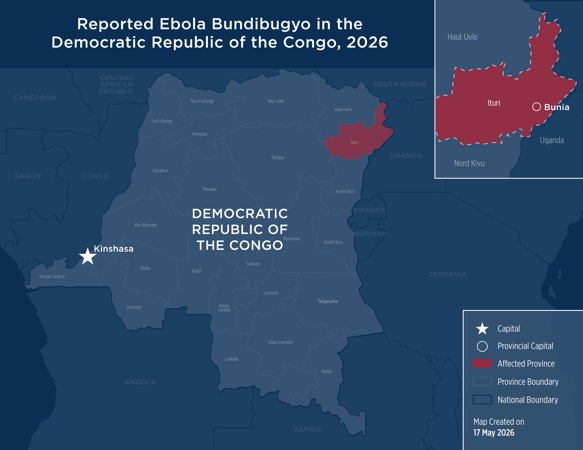 On 15 May, DRC officials declared an outbreak of Ebolavirus in the Rwampara, Mongwalu, and Bunia areas of Ituri Province near the country’s borders with Uganda and South Sudan. On 16 May, the World Health Organization (WHO) classified the outbreak as a “public health emergency of international concern” or PHEIC. This is the 17th confirmed outbreak of diseases that fall under the Ebolavirus genus, but it is only the third outbreak of the Bundibugyo Ebolavirus species.
The current count of infections stands at 600 cases and 139 deaths suspected to have been caused by Bundibugyo Ebolavirus. Of these, 51 cases in the DRC and two cases in Uganda have been confirmed. The number of both suspected and confirmed cases is likely to rise due to the lag time between presentation of possible symptoms and the definitive detection of the virus through lab testing.
The outbreak likely began between two to four months ago in Mongbwalu—a gold mining hub some 85 kilometers north of the provincial capital of Bunia—before spreading to Rwampara and Bunia through infected persons seeking treatment. The initial symptoms of Bundibugyo Ebolavirus resemble other pervasive respiratory and viral infections present in the area, and early cases went undetected. The earliest suspected case dates to 24 April when a healthcare worker reported fever, hemorrhaging, and vomiting before succumbing to the virus at a medical center in Bunia.
Unlike other species of Ebolavirus, including the better-known Zaire Ebolavirus that killed over 11,000 people in West Africa between 2013 and 2016, there are no approved vaccines or therapies for Bundibugyo Ebolavirus. Treatment consists solely of supportive care, but early medical intervention can be lifesaving.
Response
Due to the lack of a vaccine—experts at the World Health Organization estimate it could take up to nine months to develop one for Bundibugyo—containment efforts are focused on isolating cases, tracing contacts, educating exposed communities, and preventing further transmission. In addition to the medical challenges, the WHO-led international effort to break the transmission chain faces substantial sociopolitical challenges, including poor infrastructure, conflict, and traditional burial practices.
The presence of Bundibugyo Ebolavirus was only confirmed on 15 May after samples were transported some 1,700 kilometers from Ituri to the capital Kinshasa for lab testing. Subsequent contact tracing efforts were hampered by regional insecurity and highly mobile populations. Several contacts became symptomatic and died before they could be isolated.
Ituri Province is home to somewhere between 5.5 and 5.7 million people, of whom more than 270,000 are internally displaced. In neighboring North Kivu Province, armed conflict between the Rwanda-backed M23 paramilitary and DRC forces has seen more than a million people displaced and multiple instances of militia groups detaining and attacking international aid workers.
Transmission has also been accelerated by local traditional funeral rites, which involve extensive post-mortem contact with Ebola victims in the form of washing, dressing, and crying over the deceased. Ebolavirus is at its most contagious directly after death, and locals are often highly resistant to altering burial practices they believe are essential to the spiritual well-being of their loved ones in the afterlife. On 21 May, a medical center in Rwampara was partially burned following a dispute between medical staff and the family of a suspected Ebola victim over disposal of their remains.
Implications
Movement to and within the affected area is likely to become increasingly difficult as both international and national policies are implemented to reduce the frequency and extent of contacts. Aside from these policies, it is highly unlikely that Bundibugyo Ebolavirus will substantially impact health and safety or the ability to travel outside of the affected region. Within the affected region, restrictions are already tightening—Uganda has banned large gatherings and suspended flights to and from the DRC.
The U.S. is implementing a total ban on non-U.S. passport holders who have been to the DRC, Uganda, or South Sudan in the previous 21 days. U.S. citizens and permanent residents who have been to those countries in the past 21 days are exempt from this travel restriction but will be routed to one of six major U.S. airports and will undergo screening at their arrival gate.
The airports are John F. Kennedy Airport (JFK) in New York, Newark Liberty Airport (EWR) in New Jersey, Hartsfield-Jackson Atlanta Airport (ATL) in Georgia, O'Hare Airport (ORD) in Illinois, Washington Dulles Airport (IAD) in Virginia, and Los Angeles International Airport (LAX) in California. At these airports, only those U.S. citizens and permanent residents who have traveled to one of the proscribed countries in the previous three weeks will be screened for symptoms, fill out questionnaires, and provide contact-tracing information. The symptoms screen will consist of visual observation by trained staff and temperature checks with infrared no-contact thermometers. Travelers who present symptoms will be transferred to a secondary location for further examination.
Recommendations
- Global Guardian recommends avoiding all non-essential travel to the Democratic Republic of the Congo, Uganda, and South Sudan.
- Firms with personnel in the region should develop and implement check-in and contact tracing protocols for employees.
- Non-U.S. passport holders who have planned travel to the U.S. should not visit the DRC, Uganda, or South Sudan to avoid being barred from entry to the U.S.
- Firms with assets and/or personnel in the region should facilitate employee education and familiarization with the symptoms and transmissibility of Bundibugyo Ebolavirus.
Standing By To Support
Global Guardian’s affiliated medical provider, Cleveland Clinic, offers additional information on Ebolavirus through its online health resources.
Global Guardian is closely monitoring the situation and can support clients who need assistance with local teams in the area to provide:
- Medical support and consultation
- Emergency response
- Intelligence reports
- Risk assessments and resilience planning
Click below to contact Global Guardian's 24/7 Operations Center or call us directly at +1 (703) 566-9463.