


Executive Summary
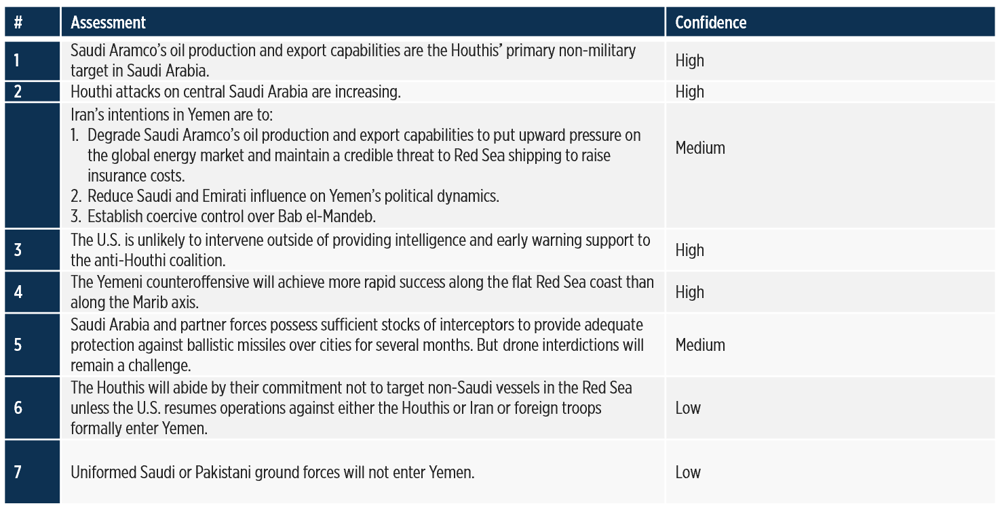
The war in Yemen is escalating along with an increase of Houthi attacks on Saudi Arabia. Following the 04 October initiation of a Saudi-backed Yemen counteroffensive, threats to Saudi Arabia are likely to escalate as the Houthis seek to increase the economic and political costs on Saudi Arabia. Global Guardian does not assess that upcoming major international conferences, including the Future Investment Initiative (FII) Conference, will be deliberately targeted by the Houthis. However, the Houthis have already intensified their cross-border attacks on Saudi airports, including three recent strikes on Riyadh King Khalid International Airport (RUH), and further attacks are likely in the coming days and weeks.
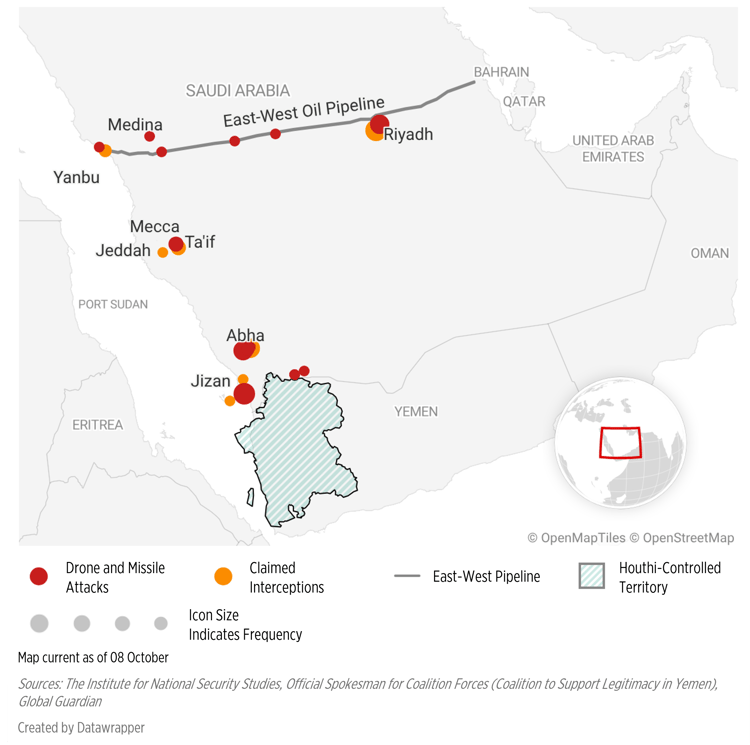
The Houthis’ primary targets in Saudi Arabia are oil and gas infrastructure and airports. Excluding the provinces of Aseer, Jazan, and Najran, the main threats facing travelers visiting Saudi Arabia are conflict-related flight delays and falling debris from interceptions. Saudi interceptors have largely been successful, but the Saudi government is censoring media around these events making it difficult to verify Houthi strikes. Repeated successful strikes on Saudi cities would indicate that the Houthi anti-Saudi strategy has shifted, raising the risks to personnel on the ground.
Recommendations
- Defer non-essential travel to Riyadh.
- Avoid all travel to southern Saudi Arabia, including the provinces of Aseer, Jazan, and Najran.
- Firms with planned travel to Saudi Arabia should closely monitor the situation in Yemen and establish triggers for evacuation or trip cancellation.
- Firms operating in Saudi Arabia should develop business continuity plans with clear triggers for adjusting office operations.
 Intro
Intro
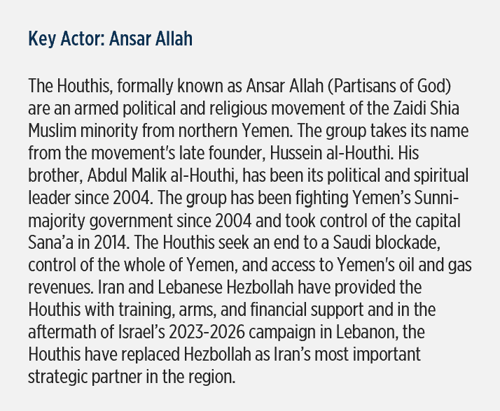
The current Saudi-Houthi conflict commenced on 13 July 2026, when the Houthis attempted to facilitate the arrival of an aircraft from Tehran at Sana’a airport, challenging the coalition-imposed blockade. Coalition forces struck the runway to prevent the landing. On 20 July, the Houthis subsequently launched missile and UAV attacks against Saudi Arabia and declared a maritime blockade on Saudi-linked shipping, marking the collapse of the ceasefire that had largely held since 2022.
The resurgence of conflict in Yemen is inextricably linked to the ongoing regional war with Iran. Given Saudi Arabia’s increased reliance on the Red Sea for oil exports to bypass the contested Strait of Hormuz, and the dissolution of the UAE-aligned Southern Transition Council (STC) in Yemen, which raised questions about the cohesion of anti-Houthi forces, it is likely the Houthis saw an opportunity to press Saudi Arabia into conceding to its demands, including ending its embargo on Houthi-controlled territory, the sharing of Yemeni oil revenues, and granting the Houthis official state recognition.
Situation Report
On 04 October, Yemen’s Chairman of the Presidential Leadership Council (PLC), President Dr. Rashad Mohamed Al-Alimi, announced “Operation Yemen Dawn,” a major offensive campaign against the Houthis with the stated goals of recovering all Houthi-held territory and restoring state authority across Yemen. Operation Yemen Dawn integrates Saudi airstrikes with coordinated government offensives along the western coast, in the Bab el-Mandeb area, and on the Al Jawf and Marib fronts.
Yemeni government forces recaptured the southern portion of Dhubab district, overlooking Bab el-Mandeb, and are attempting to set the conditions to recapture Mocha. The Houthis are attempting to envelop Yemeni forces around Taiz from the south, threatening access to the main road connecting Taiz to Aden. The group is also attempting to disrupt operations at Aden International Airport (ADE), launching missiles and drones at the airport on 06 October.
The counteroffensive is a reaction to the major collapse suffered by government-aligned forces along the Red Sea coast when the Houthis captured the city of Mocha on 11 September. Houthi forces captured approximately 140 kilometers of Red Sea coastline, and seized four islands, granting the group control over the Bab el-Mandeb Strait.
The Houthis targeted a Saudi Aramco refinery in Riyadh on 05 October in retaliation for Saudi airstrikes conducted during the opening hours of Operation Yemen Dawn. The strike on Riyadh comes after two previous strikes on the capital, on 19 September and on 03 October, in addition to unsuccessful attempts on 25 and 26 September.
Houthi officials warned their strikes on Saudi Arabia will become "more searing and more expansive," and cautioned airlines to avoid Saudi airspace. On 06 and 07 October, the Houthis struck Riyadh King Khalid International Airport (RUH) and Abha International Airport (AHB), resulting in three deaths, 26 injuries and material damage. On 08 October, eyewitnesses reported a brief evacuation of Riyadh King Khalid International Airport, along with the arrival of ambulances and fire crews following a Houthi strike on the airport.
In a sign of the increasing internationalization of the Yemen conflict, Saudi Arabia, Turkey and Pakistan announced the activation of the Mecca Joint Defense Agreement, following an emergency meeting in Riyadh on 05 October. Pakistan has deployed 30,000-40,000 troops to Saudi Arabia over the last year and since September has been flying arms directly to Aden. According to reports, Pakistani military advisors are supporting Yemeni troops on the ground. Turkey is reportedly readying to deploy air defense systems, pilots, and aircraft to Saudi Arabia to assist with defending Saudi infrastructure as well as the holy cities of Mecca and Medina.
France also announced its decision to deploy personnel and defensive systems to Yanbu on 05 October, which comes two weeks after the UK agreed to provide Saudi Arabia with air-to-air refueling. While the U.S. has refused repeated Saudi calls for direct assistance, Washington is providing intelligence and early warning support to the anti-Houthi coalition. Iran is supporting the Houthis with military advisors.
Key Judgements
Houthi Attacks on Saudi Arabia
Impact on Saudi Arabia Travel
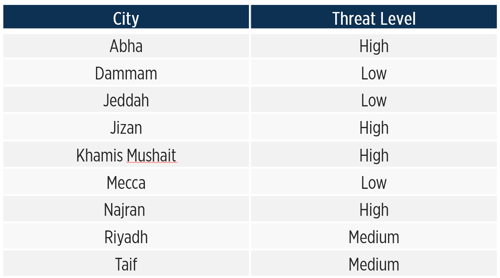 The Houthis, aided by Iran-backed Iraqi militias from the north, are centering their anti-Saudi campaign around infrastructure: oil and gas assets and airports. For the Houthis, this strategy is likely premised on raising the direct economic costs on Saudi Arabia at a time when the Kingdom is cash poor. The Houthis want to leverage high economic costs to compel Saudi Arabia to cease its military support of the Yemeni government.
The Houthis initiated their campaign in July by targeting Saudi Arabia's southern Jizan and Abha regions. But by September, the volume, depth, and political and strategic impact of strikes on Saudi Arabia materially increased, targeting as north as Yanbu and as east as Riyadh, though unconfirmed reports suggest that Saudi oil and gas sites around the Persian Gulf have been struck as well.
Houthi strikes have also caused damage at Abha International Airport (AHB), Jizan International Airport (GIZ), Najran Regional Airport (EAM), and Riyadh King Khalid International Airport (RUH). Delays at RUH have been triggered on several occasions with increasing frequency. On 05 October, the Houthis warned airlines to avoid Saudi airspace presaging further attacks on airports. Since the threat was issued, Riyadh King Khalid International Airport (RUH) was attacked on three consecutive days (06-08 October), resulting in at least one fatality and eight injuries.
Global Guardian notes the difficulty of confirming successful strikes in Saudi Arabia due to a concerted effort by Saudi authorities to prevent alarm and suppress politically damaging information, compounded by Iranian and Houthi disinformation.
Outlook
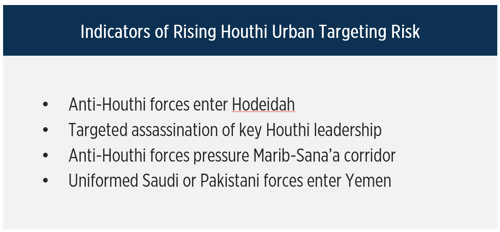 At this nascent stage of Operation Yemen Dawn, it is unclear what the goals of Saudi Arabia and the internationally recognized Yemeni government are, despite the rhetoric of recapturing all Houthi-held territory. Holding Taiz and recapturing the territory Yemen lost in September are the clear short-term objectives. But upon meeting them, it remains to be seen whether the Saudi-Yemeni coalition will attempt to find an offramp in the return to the 2022 status quo or complete its stated goal of retaking northern Yemen.
A Saudi invasion of Sa’dah or Hajjah governorates in the north or the introduction of uniformed Pakistani troops on any of the three major
axes could prompt Sana’a to intensify its Saudi pressure campaign. At present, there is little strategic value in intentionally targeting Saudi civilian population centers and antagonizing the international community as well as possible mediators including Oman and Qatar.
However, this calculation could change if the Houthis risk losing access to their deep strike arsenal or if their major ground supply lines are threatened. Repeated successful penetrations on Saudi cities would indicate that the Houthi anti-Saudi strategy has shifted. Iran may also directly intervene to protect the viability of its most
capable ally, following the weakening of its allies in Lebanon and Gaza.
KEY TAKEAWAYS
-
Houthi attacks on Saudi Arabia are increasing in frequency and have focused on energy infrastructure and airports. Repeated successful Houthi strikes on Saudi cities would indicate that the Houthi anti-Saudi strategy has shifted, raising the risks to personnel on the ground.
-
The Saudi-backed Yemeni counteroffensive is in its nascent stages. A limited campaign to restore the 2022 ceasefire lines offers the possibility of a ceasefire in the short term. A major campaign to unseat the Houthis in northern Yemen will likely run well into 2027 and feature sustained Houthi attacks on Saudi Arabia.
-
The Houthi threat to Saudi Arabia’s major cities will increase along with the pressure the Houthis face on the battlefield.
-
The conflict in Yemen is rapidly internationalizing. Major Yemeni advances and/or the entrance of foreign troops in combat roles against the Houthis increases the likelihood of Iranian intervention.
STANDING BY TO Support
Global Guardian is closely monitoring the situation and can support clients who need assistance with the following:
- Evacuation planning and execution
- Executive protection
- Secure transportation
- Emergency response
- Intelligence reports
- Risk assessments
Click below to contact Global Guardian's 24/7 Operations Center or call us directly at +1 (703) 566-9463.