


Two months ago, Brazilian President Luiz Inácio Lula da Silva looked set to win Brazil's presidential election and earn an unprecedented fourth term. However, with less than a week until the first round of voting, a far-reaching corruption scandal has once again struck Brazilian politics, tightening the polling gap of an election that will dictate the direction of Brazilian security policy and the Supreme Court.
THE ELECTION FIELD
This Sunday, 04 October 2026, Brazilian President Luiz Inácio Lula da Silva, running for the left-wing Workers' Party (PT), will seek a fourth term, facing Senator Flávio Bolsonaro of the right-wing Liberal Party (PL). Far behind in the polls are more than a dozen other candidates, including centrist Augusto Cury of the Avante party and Renan Santos of the right-wing Mission party. None have a realistic chance at the presidency, but their combined support almost guarantees that neither Lula da Silva nor Bolsonaro will win a majority in the first round, triggering a runoff on 25 October. Flávio's position is expected to strengthen in the second round, as he is a closer political fit to the rest of the election field than Lula, and will likely absorb additional voters from candidates who do not make it to the second round.
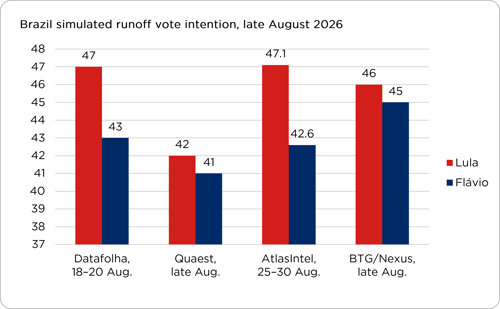
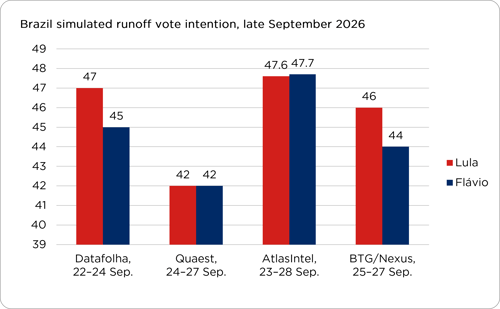
For most of the last year, Lula da Silva led voter-intention polls by a comfortable margin, but a combination of a sluggish economy and, more recently, allied implications in the Banco Master fraud scandal, has narrowed the race to a toss-up. A July Quaest poll had Lula leading Flávio Bolsonaro by a wide 45% to 37% in a simulated runoff. That gap narrowed steadily over the following weeks: An August Quaest poll put Lula ahead 42% to 41%. By late September, a BTG Pactual/Nexus survey showed Lula ahead 46% to 44%, while Quaest had Bolsonaro even with Lula at 42%—all major pollsters showing at most a 2-point gap between Lula and Flávio, within the margin of error.
 .
. 
THE BANCO MASTER SCANDAL
In November 2025, Brazil's Central Bank liquidated Banco Master, led by banker Daniel Vorcaro, after the institution's credit portfolio ballooned from roughly R$1.4 billion to R$40 billion through the sale of high-yield, government-insured deposits, with new investor cash used to pay out earlier obligations in a Ponzi-like scheme. The bank used fictitious and overvalued assets, forged documents, and fake credit portfolios to conceal the fraud, which required a bailout exceeding R$50 billion, the largest in Brazilian history.
The scandal first drew in Flávio Bolsonaro in May 2026, when leaks revealed that Flávio had negotiated with Vorcaro for USD $24 million to finance a biographical film about his father, former President Jair Bolsonaro. Flávio is now under formal investigation over the arrangement, which undercut his anti-corruption messaging and likely caused a drop in his polling that month.
In September 2026, the scandal reached Lula allies in the Supreme Court, principally Justice Alexandre de Moraes, who in 2025 played the leading role in the trial and conviction of Jair Bolsonaro for a 2023 coup d'état attempt. Alexandre de Moraes's wife, Viviane Barci de Moraes, signed a legal contract worth about USD $25 million over three years for her firm to represent Banco Master before the Central Bank, tax authorities, and Congress.
Reports allege Moraes himself edited terms of that contract and repeatedly called the Central Bank president while the bank's fate hung in the balance. Separately, leaked phone messages suggest that Moraes effectively acted as Daniel Vorcaro's personal lawyer, with Vorcaro reportedly reaching out to him directly in an effort to get investigations into the bank halted. Moraes has denied wrongdoing and called the messages a fabrication.
RISK OF UNREST
So far, no major disruptive election-related protests have emerged. Campaign activity has included large candidate rallies and organized pro-Lula mobilizations across dozens of Brazilian cities. The 2026 election is considerably less politically charged than the 2022 cycle, when Brazil experienced widespread post-election unrest, with Bolsonaro supporters blocking highways, staging mass demonstrations, and ultimately storming government buildings in Brasília in January 2023.
Flávio has publicly pledged to respect the outcome of the 2026 vote, but has also repeatedly questioned the security of Brazil's electronic voting machines, and has pushed for printed ballots and more international observers. Brazilian election authorities have rejected these claims, but the consistent messaging line from Flávio undermines confidence in the vote and raises tensions ahead of what is likely to be a close runoff.
IMPLICATIONS OF A BOLSONARO VICTORY
Brazil's 2026 election is extremely consequential. A Bolsonaro win would mark a sharp swing back toward the right after four years of Workers' Party governance, and markets would likely read it as favorable in the near term, given investors' perception of Flávio as more fiscally orthodox and business-friendly than Lula.
Politically, a Bolsonaro presidency would likely pursue amnesty or reduced sentences for participants in the January 2023 Brasília riots, including for his father. A Flávio win would also likely reset relations with Washington, ending the Trump administration's use of trade tariffs to pressure the Lula government. Further, the next president of Brazil will have the opportunity to reshape the Supreme Court for a generation, as one spot is currently vacant, and three justices are set to retire in the next four years.
Perhaps the most significant effect of a Flávio presidency would be the expanded U.S.-Brazil security cooperation that would almost certainly follow. The Trump administration has been intensely focused on amplifying security and military alliances across the Americas through intelligence sharing, equipment, and joint operations.
Brazil would likely join the Shield of the Americas, a coalition of Latin American and Caribbean nations led by the United States to tackle organized crime through military force. This strategy would align with Flávio's own campaign promises to build Bukele-style mega prisons, treat domestic gangs as terrorist groups, and generally increase penalties for criminals.
STANDING BY TO Support
Global Guardian is closely monitoring the situation and can support clients who need assistance with the following:
- Evacuation planning and execution
- Executive protection
- Secure transportation
- Emergency response
- Intelligence reports
- Risk assessments
Click below to contact Global Guardian's 24/7 Operations Center or call us directly at +1 (703) 566-9463.