<img height="1" width="1" src="https://www.facebook.com/tr?id=755385498933168&amp;ev=PageView%20&amp;noscript=1">

Explore Case Studies

Lorem Ipsum Dolor Sit Amet

Lorem Ipsum

Emergency Response
traveler-security-icon

Lorem Ipsum Dolor Sit Amet

Lorem Ipsum

Emergency Response
traveler-security-icon

Lorem Ipsum Dolor Sit Amet

Lorem Ipsum

Emergency Response
traveler-security-icon

In 2027, energy market volatility, the rapid evolution of artificial intelligence, escalating public health threats, and a growing potential for conflict and unrest will define the global risk landscape. Businesses and organizations must recognize how these dynamics—evident this year in a war that disrupted global oil markets, a public backlash against AI infrastructure, and the second-largest Ebola outbreak on record—may expose their people, assets, and operations.

To help corporate leaders and travelers better assess the global risk landscape, Global Guardian publishes a yearly global risk assessment. Inside this year's assessment, you'll find:
The 2027 Global Risk MapGG RiskMap 2026 Download Email V1-06

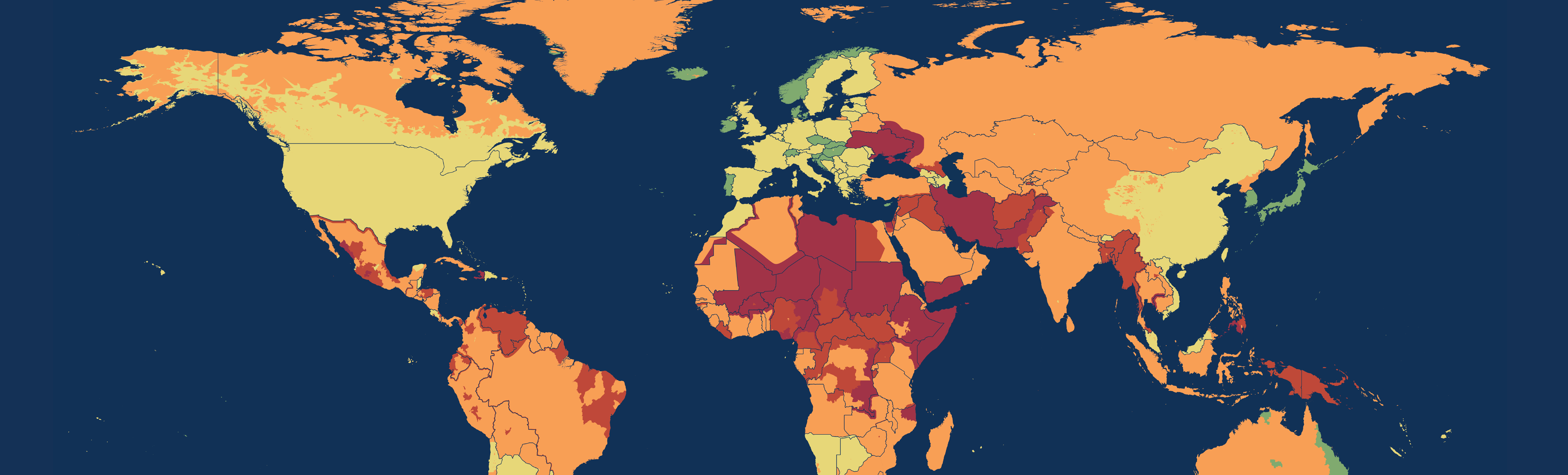
  • This risk map displays country-specific security risk levels based on a series of indicators including crime, conflict, health, natural disasters, infrastructure, political stability, civil unrest, and terrorism.
  • New this year: our risk map now includes granular, intra-national risk designations, so a single country can carry more than one rating and you can see how risk varies inside its borders, not just between countries.
  • The map also names the specific countries with the highest arbitrary detention, health, environmental, and data exposure risk, along with the cities with the highest violent crime.

Complete the form below to explore the interactive Global Risk Map and download your copy.

 

View and Download Map

Frequently Asked Questions

What risks are covered in the 2027 Global Risk Map?

The 2027 Global Risk Map covers a comprehensive set of threats that shape the global security landscape, including crime, conflict, health, natural disasters, transportation and infrastructure, political stability, civil unrest, and terrorism. Each country is evaluated across these indicators to show where risks are escalating or receding, helping organizations and travelers understand exposures and prepare for the year ahead.

What's new about the 2027 Global Risk Map?

This year's map layers five risk category callouts on top of the overall country ratings: Highest Risk Cities, Highest Arbitrary Detention Risk Countries, Highest Health Risk Countries, Highest Environmental Risk Countries, and Highest Data Exposure Risk Regions. A country can carry a moderate overall rating and still be flagged in one or more of these categories, so the type of risk is visible, not just its level.

The map also goes below the country level for the first time. A single country can now carry more than one rating, reflecting how risk actually varies within its borders rather than applying evenly nationwide.

What do the new risk categories indicate?

  • Highest Risk Cities: Extremely high rates of homicide and other violent crime, driven by conflict between organized criminal groups, quasi-state actors, and/or government forces.
  • Highest Arbitrary Detention Risk Countries: Countries with a record of detaining foreign nationals without legitimate cause to create diplomatic leverage, often coinciding with a deterioration in diplomatic relations.
  • Highest Health Risk Countries: Countries with prevalent or endemic contagious diseases, underdeveloped healthcare infrastructure, or challenges with evacuation.
  • Highest Environmental Risk Countries: Countries with a high prevalence of extreme weather or seismic events combined with a limited capability to respond effectively.
  • Highest Data Exposure Risk Regions: Regions with robust cyber capabilities, weak privacy protections, and a pattern of commercial espionage or intellectual property theft.

How can businesses use the Global Risk Map?

Businesses can use the 2027 Global Risk Map to identify vulnerabilities, guide resource allocation, and strengthen resilience. The map highlights country-specific risks, from crime and civil unrest to natural disasters and terrorism, while its new granular categories pinpoint exactly where risks like arbitrary detention or data exposure are most likely to affect personnel and operations. When combined with tabletop exercises and scenario planning, these tools help organizations move beyond reactive responses to proactively prepare for disruptions, protect assets, and ensure business continuity in a volatile global landscape.

Do people who only operate in low or moderate risk countries have nothing to worry about?

Risk is the product of probability and impact. Just because the probability of an untoward event is low, it doesn’t mean that a high-impact event cannot occur. Natural disasters, opportunistic crime, and terror attacks can happen almost anywhere, any place, at any time. Proper precautions should always be undertaken ahead of travel.